

WHC Lab
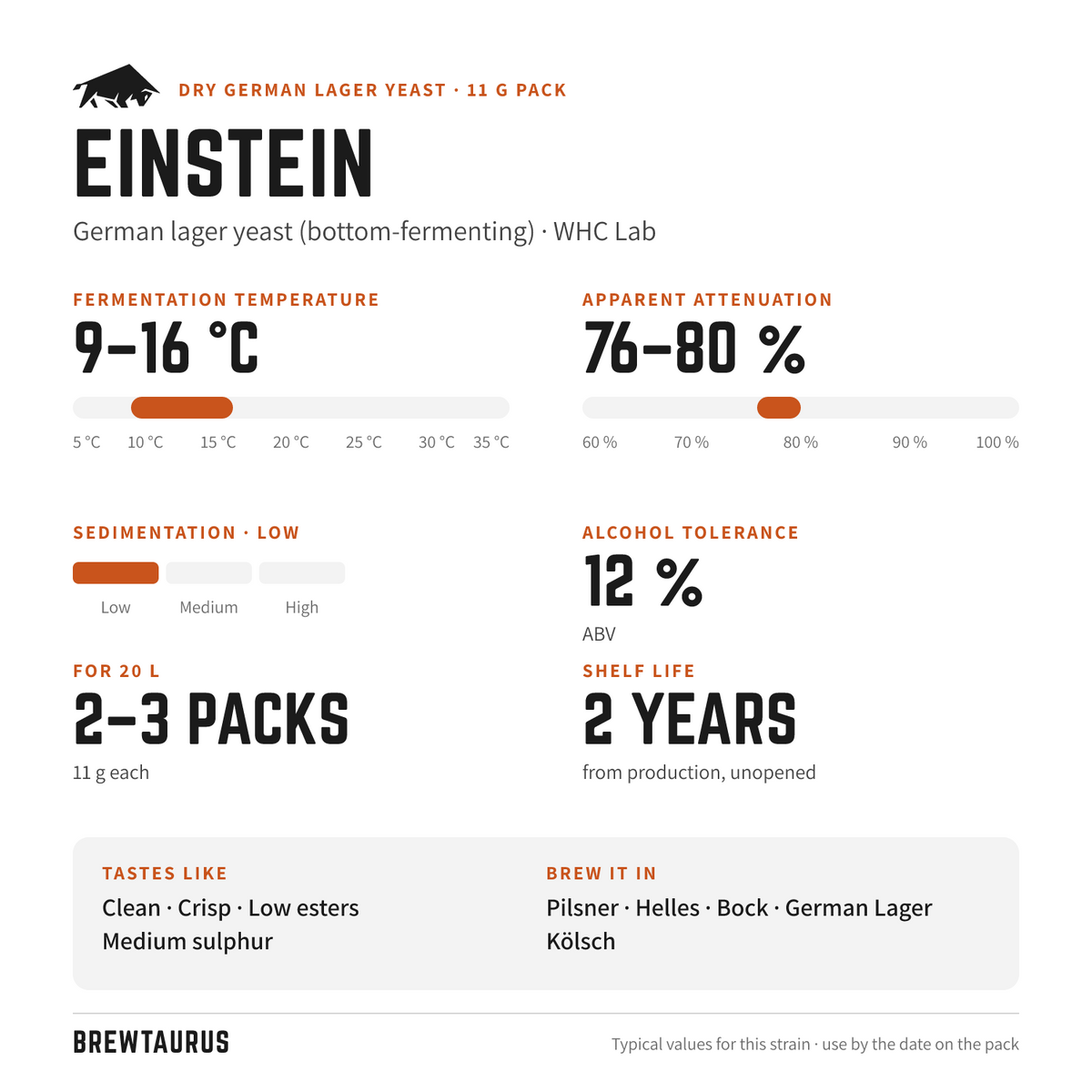
WHC Lab Einstein · Dry German Lager Yeast · 11 g
WHC Lab Einstein · Dry German Lager Yeast · 11 g
Key specs
- Attenuation
- 76–80 %
- Ferment at
- 9–16 °C
- Flocculation
- Low
- Alcohol tolerance
- 12 %
- Form
- Dry
- Dosage
- 100–150 g/hl (two to three 11 g sachets per 20 L)
Flavour clean · crisp · low esters · medium sulphur
Ships from our partner warehouse in Czechia, in its own parcel
Shipping to Czechia: €4.90 up to 9 kg · How it works
Crew Free shipping with 250 points (covers this parcel up to €12.90) · Join free
🚚 Shipping to Czechia: €4.90 · FREE over €149
Ships from our ingredients partner in the Czech Republic · Shipping details
Crew Earns 6 Crew points · How it works
Pairs well with


Read customer reviews · ✓ 2-year EU warranty
Couldn't load pickup availability
Low esters, a crisp finish and a medium sulphur note, well within what a German lager wants. Ferment Einstein cold, at 9–16 °C, and your Pilsner, Helles or Bock tastes of malt and hops rather than yeast.
Saccharomyces pastorianus · 9–16 °C · Attenuation 76–80 % · Low flocculation · Low esters · 100–150 g/hl · 11 g sachet
What it does in your beer
Einstein ferments clean and crisp with low ester formation, so your malt and hops set the character. Sulphur production is medium, which WHC Lab says is well within the desirable range.
It's a Saccharomyces pastorianus strain for cold fermentation at 9–16 °C, attenuating 76–80 % with low flocculation and a 12 % ABV tolerance. WHC Lab names Pilsner, Bock and Helles, and lists Kölsch alongside lagers.
At a glance
| Manufacturer | WHC Lab (Co. Wicklow, Ireland) |
| Strain / type | German lager yeast, bottom-fermenting (Saccharomyces pastorianus) |
| Form | Dry yeast |
| Pack size | 11 g sachet |
| Attenuation | 76–80 % |
| Flocculation | Low |
| Fermentation temperature | 9–16 °C |
| Alcohol tolerance | 12 % ABV |
| Nitrogen demand | Low |
| Esters / sulphur | Low / medium |
| Dosage | 100–150 g/hl |
| Rehydration | Not needed — pitch dry |
| Viable cells | 4.0 × 10⁹ cfu/g (typically 1 × 10¹⁰) |
| Beer styles | Pilsner, Helles, Bock, German lagers, Kölsch |
How much for a 20 L batch
WHC Lab recommends 100–150 g/hl. For 20 L (0.2 hl) that's 20–30 g, i.e. two to three 11 g sachets (approx., dosage × 0.2 hl).
One sachet on its own (55 g/hl in 20 L) is below the recommended rate.
How to use
- Pitch dry onto wort that's already cooled into the 9–16 °C range. No rehydration or oxygenation for this one: WHC Lab's data sheet says neither is necessary and advises avoiding both unless the lager is very high gravity.
- Ferment cold, at 9–16 °C.
- A little sulphur during fermentation is expected from this strain — WHC Lab rates its production as medium.
- Spare yeast in an opened sachet: reseal, refrigerate at 0–10 °C, use promptly.
Pairs well with
Brewing a Helles or Pilsner? Try it with Czech Pilsner Malt as the base, a touch of Weyermann® CARAHELL® and Northern Brewer for bittering. For a Bock, add Weyermann® Munich Type 1.
Storage & shelf life
- Sealed sachets: dry, cool to ambient, ideally 5–15 °C. Bought three for a lager? The spares keep the same way.
- Shelf life: 2 years or more from production, as long as the seal holds and storage is right.
- An opened sachet: reseal against air and moisture, 0–10 °C in the fridge, use promptly.
Food information
- Food business operator: WHC Lab Limited, Ballinree House, Prospect Upper, Newcastle, Co. Wicklow, A63 HK02, Ireland
- Name: Dry brewing yeast
- Ingredients: yeast (Saccharomyces pastorianus) 98.8–99.2 %, emulsifier: sorbitan monostearate (E491) 0.8–1.2 %
- Allergens: no added allergens (WHC Lab safety data sheet)
- Net quantity: 11 g
- Storage: cool and dry, ideally 5–15 °C
Údaje o potravině (CZ)
- Název: Sušené pivovarské kvasnice
- Složení: kvasnice (Saccharomyces pastorianus) 98,8–99,2 %, emulgátor: sorbitan-monostearát (E491) 0,8–1,2 %
- Alergeny: bez přidaných alergenů (bezpečnostní list WHC Lab)
- Čisté množství: 11 g
- Skladování: v chladu a suchu, ideálně 5–15 °C
- Provozovatel potravinářského podniku: WHC Lab Limited, Ballinree House, Prospect Upper, Newcastle, Co. Wicklow, A63 HK02, Ireland
Good to know
- Plan on two or three sachets for a 20 L lager — WHC Lab's recommended dose starts at 100 g/hl.
- Low nitrogen demand on WHC Lab's rating.
- Your yeast ships from our partner warehouse in the Czech Republic, separately from any equipment in the order.
FAQ
How many sachets of Einstein for 20 L?
Two to three. WHC Lab's 100–150 g/hl works out at 20–30 g for 20 L.
What temperature should I ferment Einstein at?
9–16 °C.
Is a sulphur smell during fermentation a problem?
Einstein produces medium sulphur, which WHC Lab describes as well within the desirable range.
Einstein or Blitz Lager?
Einstein is a bottom-fermenting Saccharomyces pastorianus for cold fermentation at 9–16 °C. Blitz Lager is a Saccharomyces cerevisiae strain selected to give a clean lager character at 16–20 °C.
SKU:BOP-2029
View full details